Showing posts with label politics. Show all posts

Friday, August 24, 2018

No, impeachment will not crash the stock market

https://www.politico.com/amp/story/2018/08/23/donald-trump-impeachment-stock-market-economy-750277

NEW YORK— The longest bull market run in American history could get killed off by a financial collapse in Turkey, a policy mistake by the Federal Reserve or a plain old economic recession.

It will probably not be slain by an impeachment of President Donald Trump.

Story Continued Below

This browser does not support the Ad element.

That’s the consensus view of Wall Street traders and money managers, who say that while an ugly impeachment fight might cause temporary volatility, markets could easily survive an impeachment and even the unlikely event that Trump is removed from office in a Senate trial.

In fact, Wall Street pros often talk about a potential relief rally if Trump departs the White House early.

The underlying economy would remain strong, and a hypothetical President Mike Pence would likely continue Trump’s policy of low taxes and fewer regulations without all the wild tweeting and investigations and persistent trade wars.

“I’m not sure the market would be all that upset by Trump being forced to leave,” said Jim Paulsen, chief investment strategist at the Leuthold Group. “Many Republicans might welcome it, and if Pence moves in, the basic low regulation, low tax nature of the presidency would be the same, only without the constant self-induced volatility, and maybe ‘trade wars' would diminish.”

Trump took a very different view in an interview with Fox News that aired Thursday morning, saying the stock market likely would collapse if he were impeached.

“I will tell you what, if I ever got impeached, I think the market would crash. I think everybody would be very poor,” he said, amid new legal turmoil this week with two former advisers, Paul Manafort and Michael Cohen, now guilty of criminal acts.

Trump loves to bask in the stock market advance under his presidency and boasted this week about the length of the bull market. And stocks have indeed celebrated his policies on taxes and regulation.

But markets now move very little on news of fresh legal trouble for Trump. And analysts say that’s in part because the economic and stock market recoveries long predate Trump’s presidency and would probably live on without him.

“Fading trade wars, no change in corporate taxes and the deregulatory air in Washington would be something of a ‘Washington Goldilocks’ situation,” Michael Obuchowski, portfolio manager at Merlin Asset Management, said of a potential impeachment.

When Wall Street analysts list risks to the current market, they most often cite external turmoil, such as the currency crisis that recently rocked Turkey or the Fed moving too fast — or too slow — on interest rates. Geopolitical tensions in the Middle East and the Korean Peninsula also show up as potential destroyers of a bull market born in the ash heap of the 2009 financial crisis.

They sometimes cite political uncertainty surrounding Trump, but that is usually couched as the potential for trade wars and other unpredictable policies, not the threat of his removal.

Wall Street analysts generally agree that a protracted impeachment fight and potential Senate trial could weigh on stocks, giving Trump the opportunity to claim vindication for his market crash prediction. But they say any drop on Wall Street would be based on the uncertainty of the outcome of such a fight rather than real fear of a post-Trump presidency.

Stefanie Miller, a senior analyst at Height Capital Markets in Washington, said investors would be unnerved by any impeachment effort because of the instability that would bring.

"I do NOT think the market will shrug off impeachment proceedings in the House, even if they don’t lead to a conviction in the Senate," she said in an email. "Based on frequent conversations I’ve had with investors, I don’t get a sense that many would welcome the instability/headline risk stemming from those proceedings."

A larger concern among some investors is that Trump survives but Republicans are so damaged by him that they lose both the House and Senate, putting market-friendly policies more at risk.

“If the scandal helps both the House and Senate to go Democrat to a point where they could reverse tax or regulatory policies, that would matter to the markets,” Paulsen said. “But this seems unlikely, and even if both go Democrat it would mean gridlock for Trump’s term, not much different.”


Friday, January 26, 2018

Wednesday, January 24, 2018

Saturday, January 20, 2018

Government shuts down as lawmakers still searching for a deal

http://edition.cnn.com/2018/01/19/politics/government-shutdown-trump-congress-latest/index.html


Thursday, January 11, 2018

Trump's 'sh**hole' comment is his new rock bottom - CNNPolitics

Trump's 'shithole' comment is his new rock bottom - CNNPolitics: On Thursday, in a meeting with a senators and House members on immigration, the President of the United States, asked this: "Why do we want all these people from 'shithole countries' coming here?"

Tuesday, January 09, 2018

Friday, October 20, 2017

A liberal is a conservative whose house just flooded

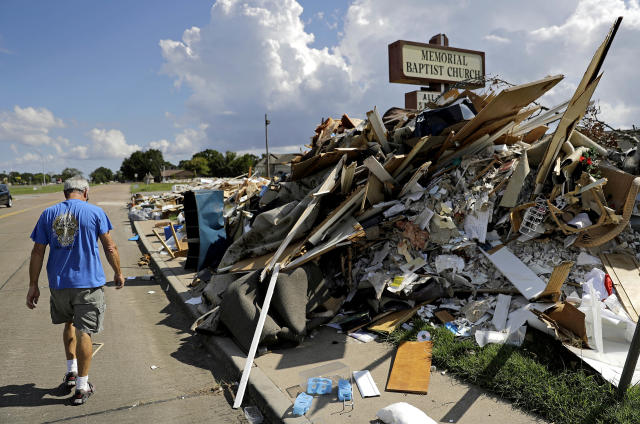
Last week, the Washington Post ran an article from Port Arthur, Texas, a Gulf Coast city that is heavily dependent on the oil industry and which was badly flooded this summer by Hurricane Harvey. The reporter found that some Trump voters, confronted with evidence that climate change may pose a risk to environments closer to home than the North Pole, were rethinking their opposition to measures to reduce carbon emissions. But it seems to be rather a close call.

One man, who described himself as an evangelical Christian and conservative Republican, had a poignant comment on this dilemma: “It’s a Catch-22 kind of thing,” he said. “Do you want to build your economy, or do you want to save the world?”

Well, environmentalists have to take their victories where they find them. A hurricane is a blunt instrument for getting voters’ attention, but, by analogy to the famous aphorism of the 1960s — “A conservative is a liberal who just got mugged” — perhaps tomorrow’s liberal is a conservative whose house just flooded.

But let’s try to help out the Washington Post’s man in the street, starting with the observation that the economy of the future will increasingly be built on renewable energy. As it happens, Texas ranks first in the nation for wind-power generation, with nearly 12,000 turbines that in addition to electricity, have generated more than 22,000 jobs. That is, of course, a small fraction of oil and gas employment in the state, but the petroleum industry enjoyed a hundred-year head start — and while only a few states have significant oil and gas production, the wind blows and the sun shines everywhere, creating renewable-energy jobs in such states as Iowa and Vermont.

The number of jobs in clean-energy industries is said to be around 3 million, roughly comparable (depending on how you count) to fossil-fuel employment. Not all jobs are fungible, of course, but common sense suggests that someone whose job is welding pipe in a refinery could do the same thing on a windmill instead.


Of course, those workers might need to relocate, but it is probably better for them to relocate now, if the next storm will wash away their homes eventually anyway. Moving to take advantage of opportunities is a familiar part of the American experience—a key component, in fact, of the American exceptionalism conservatives claim to worship, in contrast to the parochial, tradition-bound villages and towns of the Old World. Paradoxically, the party that self-identifies with risk-taking, innovation and entrepreneurship is also the one committed to preserving an energy economy from the 19th and early 20th centuries.

But the bigger issue is that while the economy has always gone through cycles of boom and bust and will again in the future, the world can end only once. Many Americans might even think it’s worth saving even if the process shaves a few basis points off the GDP. The fact that some people — including the ones running the U.S. government and its environmental agencies — apparently disagree is an especially glaring example of the failure of moral imagination that pervades American politics.

Those in a position of leadership who refuse to take action on climate change follow in the footsteps of Louis XV, one of France’s Bourbon kings, who surveyed his restive kingdom and commented, “After me, the deluge.” Louis meant it figuratively, but the deluges we face today are actual. The story brings to mind President Trump trying to finish a round of golf before the next hurricane dumps three feet of rain on his head.

Maybe the problem is just that solipsism is the default human condition. Former Sen. Bob Dole of Kansas, on most issues an orthodox conservative Republican of the pre-tea party era, was known for his advocacy for the disabled. This was an issue that sometimes put him at odds with his own party, notably a few years ago, when his erstwhile Republican colleagues voted down approval of the United Nations treaty on disability rights, after the long-retired Dole made a personal appeal in its favor on the Senate floor.

But Dole was disabled himself, barely able to move his right arm as a result of an injury in the World War II. His stance was admirable, but would have been even more so had he come to it as a result of seeing someone else struggle with a disability. I respect Sen. Rob Portman, R-Ohio, for bucking his party to become a (relatively) early supporter of gay marriage, but I would respect him more if he had reached that position before his own son came out to him as gay, rather than after. Why didn’t “the Bible’s overarching themes of love and compassion and my belief that we are all children of God” matter to him when it was just the happiness of other people’s children at stake?

As far as global warming is concerned, the Climate Solutions Caucus, a bipartisan group in the House founded in 2016 by two Florida congressmen, Republican Carlos Curbelo and Democrat Ted Deutch, is now up to 60 members. That is an increase of 10 since July, before the latest round of hurricanes. One new member, as of March, is Rep. Darrell Issa, R-Calif., whose conversion represents either a stunning reversal of Issa’s long-standing climate science denial, or a desperate move to the center to hold on to his seat in an increasingly liberal district. “Building bipartisan support for fighting climate change is a worthy cause — but we need real action, not just rhetoric,” says Sara Jordan, a League of Conservation Voters’ legislative representative, in an interview with Yahoo News. “Some of these members may be using the caucus to seem more moderate than they actually are.”

It will be hard to gauge the sincerity of Issa’s newfound belief in climate science any time soon, because there will be a 500 mph hurricane before the House Republican leadership brings a global warming bill to the floor, where members would have to take a stand on it. But for conservative Republican voters who are starting to realize that what comes to the Federated States of Micronesia will come eventually to Biscayne Bay, the important question is what they plan to do about it now. As the man quoted in the Post said,  “You can make all the money in the world here. If you don’t have a world, what good is it going to do you?”

Good question.

Full Article